What Will Pay for All Those Data Centers?
Bloomberg’s chart shows the companies it groups as technology going from a little over a quarter of the S&P 500’s market value at the end of 1999 to about half on October 19, 2026. The black band is hard to miss, but I kept looking at the pink one marked Health Care. What if the black band gets wider because AI makes it affordable to do work that companies in the other colors have been putting off?
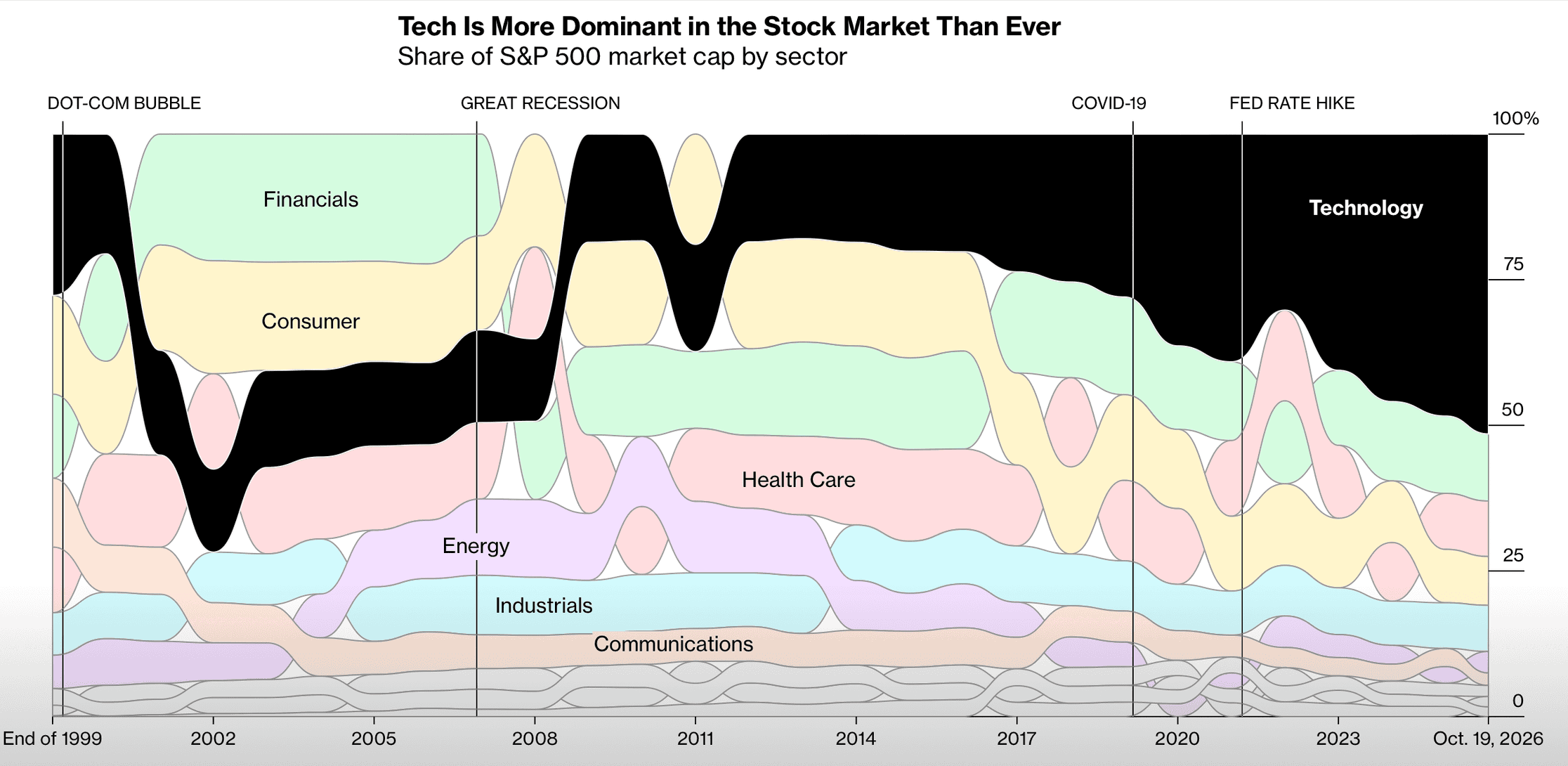
Bloomberg chart. Share of S&P 500 market value by sector through October 19, 2026.
Bloomberg points out that even turbine makers have a stake in the buildout. In “Compute,” I looked at what happens when a founder has to commit to computing capacity before customers start paying. A long contract can give the data center owner predictable revenue while the founder is still finding customers who will pay enough to cover the bill.
Say you run the labeling team at a medical device company. You have a new product coming out and a list of labels you need to update on products you already sell. The launch goes first, and the updates keep sliding. AI might give you a draft in minutes, but if a reviewer still has to open six documents to check the claims and send the draft back for corrections, how much time have you saved? I’d look at what it costs to get a label signed off, including the software, the reviewer’s time, and the work that has to be redone.
In The Invisible Interface, I call the time between getting an AI answer and acting on it proofseconds, including whatever checking you have to do in between. If the tool puts the source for each claim next to the draft, the reviewer can check it there before signing off. Cut enough time out of that review and the team might get to those older labels before the next launch pushes them down the list again.
More data centers can make computing easier to get, and better chips and software can make models cheaper to run. The device maker could spend less per finished label and still spend more on AI if the savings let it take on enough of that backlog.
Some of what the device maker pays for the software goes toward computing. Add up the bills of enough businesses doing more work this way and you start to see what could fill those data centers. Whether the owners earn back what they put in depends on how much computing they sell, what they can charge, and what it costs to build and run the facilities. If the profits from selling AI help the technology group gain market value faster than the rest of the index, the black band gets wider. Some of the demand behind it would have come from the other colors.
I’d ask the person paying the AI bill at the device maker which labels the team got through review that would otherwise still be on the list, and whether they’ve budgeted to do the next round. That’s where I’d start if I wanted to know what will pay for all those data centers.
References
Bloomberg News. AI Has Taken Over Every Corner of the Market. November 6, 2026.
Harry Glorikian. Compute.
Harry Glorikian. The Invisible Interface. Printed pp. 78-80 and 92-94.