I Came for One Thing
A note first. I’m not a storyteller. So, I asked an AI to help me tell it. I gave it the argument and a list of things it wasn’t allowed to pretend. It gave me Dana. Dana is fiction. What she does is real today or close to it; the last section says what had shipped on the day I wrote this.
9:40 on a Tuesday
At 9:40 on a Tuesday night in 2019, Dana Okafor was fighting a font.
She ran a two-room physical therapy clinic above a bakery and lived above the clinic, so the whole building smelled like a reward she didn’t have time for. Her daughter Priya was asleep upstairs, or pretending. On the kitchen table: a denied insurance claim and a laptop with three windows open. The spreadsheet with the visit dates. The letter template her old partner built in 2011 that nobody dared touch. The billing portal, which logged her out every eleven minutes on principle.
Copy the dates out of the spreadsheet. Paste them into the letter. The font changed. Fix the font. Wrong column. Fix the column. The portal logged her out.
She was good at this. That was the problem. She’d bought each of those programs the way you buy a drill: you need a hole; you buy the thing that makes holes. None of them had ever been asked to do anything else. The appeal needed all three, and the thing between them, the carrying, was her.
In the drawer under the table was a pad of blank exercise sheets with a list on it titled Someday. Learn enough Spanish for the Ruiz family. Figure out the reimbursement rules instead of guessing. A stretching game for the teenagers who lie about doing their stretches. Next to the game, in smaller letters: I don’t know how.
The software had never once asked what she wanted. It asked which menu.
January
Seven years later, in January 2026, she paid for AI access for exactly one reason. The letters.
She briefed it like a temp. Here’s a denied claim for a shoulder, here’s why it shouldn’t have been denied, write the appeal. Patient details stripped out first, because she’s not an idiot and her compliance training had a slide about it.
It wrote the appeal. Decent. A little too polite. She fixed two sentences, added the patient’s details back inside her own system, and sent it. Then she typed thank you, felt stupid, and closed the laptop.
That was supposed to be the whole relationship.
Spring
By March she was coming back for things that had nothing to do with letters.
The reimbursement rule changed again. She pasted it in and typed: explain this like I’m smart but tired. It did. Then she asked what it meant for a clinic her size, and it told her which three lines mattered and which fourteen didn’t. She crossed a line off the Someday list without thinking much about it.
She was choosing between two scheduling systems. Side by side, she typed. Cost, what breaks when the internet goes down, what happens to my data if they get bought. She disagreed with one line of the comparison and said so. It conceded.
Priya had three college visits in April and a mother with no sense of direction. The route took a minute. Priya edited it. Priya edits everything.
The night before the lease conversation with her landlord, she rehearsed. Out loud. Late. Priya came down for water.
“Who are you talking to?”
“My landlord.”
“Mom.”
“Practice landlord.”
Same door, five reasons to walk through it. The reason she’d bought it turned out to be the smallest thing she used it for.
April, May, June
Then the help itself changed. Three times, three different ways.
April: a more capable model came out. She didn’t read the announcement. She noticed because it now got right the multi-visit claim math it had botched on an appeal in February. It knew nothing new about her. It could just do harder work. Capability.
May: she told it one thing about herself. I only do admin on Tuesday evenings. Said once, in passing, the way you tell a new assistant you take your coffee black. A week later she asked for a plan to move the clinic onto the new scheduling system, and every block of her own work in it sat on a Tuesday evening. She felt seen, then suspicious, then fine. It hadn’t got smarter. It had got to know her. Relevance.
June: she clicked two boxes. One let it see her calendar. One let it into the billing portal, the one with the eleven-minute logout, after the vendor signed the paperwork her compliance training also had a slide about. Now follow-up visits landed on the calendar on their own, and when an appeal was ready it filed the appeal itself, in the portal, while she watched it work in a small window. She could take over. She could stop it. By July she’d stopped watching. She handed it the month-end claims on her way into a session and found a list when she came out: thirteen filed, two held back because the math looked wrong. Same model, longer arms, only where she’d said so. Reach.
Capability, relevance, reach. They look identical from across the room. Every vendor on earth would love to sell them to you as one word.
The Thursday nothing changed
Then came the Thursday nothing changed.
No update. Nothing new about her. No box. Dana was at the same screen she looked at every day when the Someday list fell out of the drawer, the way lists do when you’re avoiding something.
A stretching game for the teenagers who lie about doing their stretches. I don’t know how.
She looked at the list. She looked at the screen. And it landed on her that in seven months she had only ever asked this thing for words, and then for the same paperwork with longer arms. Letters, explanations, comparisons, a route, a practice landlord, claims. It had never crossed her mind to ask it to help her make something.
The idea hadn’t changed since 2019. The thing that could build it had, back in January, and nobody had sent her a note. The system was the same as yesterday. The menu hadn’t grown. Her attention had moved.
She typed the question she had never typed into software in her life. Could you help me try?
Two Tuesday evenings
It didn’t say yes. It asked questions. How old are the patients. What counts as a stretch. Phone or tablet. Did she want it to track anything, because tracking a minor’s health data is a different project with different rules. Opens only, she said, and it goes on the parents’ consent form.
Then: plan it, draft it, show me first.
The plan had six steps and she understood all six, which had never been true of a plan involving code. The estimate was two Tuesday evenings. The learning she’d been avoiding for years became something she skimmed. The carrying, the part that used to be her, happened on its own, inside the tools she’d allowed, and it tested the result on a phone the way a fifteen-year-old would before it showed her anything.
Tuesday one: a first version. A little character, a stretch timer, a button that did nothing on the clinic’s old tablet, the one device it hadn’t tested. She pointed at the button. Fix. It fixed. She renamed the character because the first name was awful. She approved.
There was a stop control the whole time, a plain square in the corner. She never pressed it. She liked knowing it was there.
Tuesday two: it went onto the clinic tablet and the phones of the four patients whose parents had signed the consent form.
Kai, fifteen, hamstring, said it was mid. He played it nine times.
What the game did
The game was clunky. That’s not the point. The point is what it did to her next question.
Two weeks in, it spoke first. Three of the four hadn’t opened the game since Sunday; did she want it to draft a note to each parent, for her to approve one at a time? Yes, to two. No to the third, because that kid’s mother had enough going on. Nobody had told it to look. She’d allowed it to look, and it had noticed. She decided she liked that, and that afternoon she gave the game its own thread, shared with the four parents like a group chat, so the notes and the nagging stayed in one place and out of the clinic’s.
The questions came fast. Could I make a version for the therapist in the other room? Could I turn this into a ten-minute lesson for the parents, who were the actual problem? Could the Ruiz family get their instructions in Spanish without me guessing at the grammar?
So, she went back to the door. The list of things worth trying had got longer, and nobody had shipped anything.
Meanwhile, in a building she’ll never see, the computers behind all this were busy. Her brother-in-law Raj’s firm had just bought forty more seats and an always-on agent for every partner. Mostly, Raj admitted at a barbecue, to summarize email. Heavy demand, narrow use. The bill tells you nothing about how much of the menu anyone has opened.
And the real world didn’t budge. The landlord said no; practice landlords are more reasonable than real ones. The college trip cost what it cost. The parent lesson and a second game both needed hours, and she had hours for one. The lesson, yes. The second game, not yet. Friday nights with Priya, not on the table.
In the drawer, on the pad, she crossed one more line off the list. Then she crossed out the title too and wrote a new one above it.
What could I attempt next?
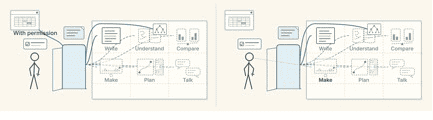
From the film of the same name. Left: the help changed three ways. Right: nothing changed; she noticed.
The moral
Here’s the aha.
For thirty years the question was: which program will help me do this? Good question. It bought a lot of drills. It also decided, every time, that you’d pick a tool to fit the job and the tool would stay what it was. Nobody asked a drill what else it could do.
Dana bought help with one task and ended up holding something else: a door she could walk through for almost anything, that changed on her in three separate ways, and that changed her. The letters got written. The letters turned out to be the least interesting thing it did.
The biggest upgrade in this story wasn’t the model in April. It was Dana on a Thursday, when nothing changed except what she was willing to ask.
So, what are you buying? The bill says tokens. What you’re paying for is access: to intelligence you can point at almost anything, that improves on someone else’s clock, and that gets more yours the longer you use it. The first task is the entry price. Everything after is option value on things you haven’t thought to ask yet.
Be clear-eyed about “more yours.” The memory, the permissions, the months of context it holds about your clinic, and your Tuesdays make it more than software. They also make leaving expensive. You’re buying access and quietly taking on a dependency. That doesn’t change the decision. It changes what you watch. Watch one thing in particular: the next products will offer to have your Thursday for you. Connect your email and they’ll decide what to build. Take the help. Keep the Thursday.
Dana came for one thing. So did I, the day I asked for help with this story. We both left with the line on her pad.
What could I attempt next?
What was real on the day I wrote this
Written October 20, 2026. The always-on, works-while-you’re-away and speaks-first beats lean on these. The rest is in products most readers already have.
- OpenAI, Introducing dots, September 29, 2026. Always-on agents on their own cloud computer that work toward your goals in the background, look for ways to help when idle through read-only connections, and route anything that touches your accounts through an approval check.
- Google, Let Gemini handle your multi-step daily tasks on Android, February 25, 2026. Gemini operates selected apps in a secure window in the background; you can view, take over, or stop the task.
- Google, I/O 2026 keynote announcements, May 19, 2026. Gemini Spark, a personal agent that works around the clock; proactive daily briefs; agents that can buy for you.
- Anthropic, What 81,000 people told us about the economics of AI, April 22, 2026. Self-selected users report taking on new kinds of tasks, not just doing familiar ones faster. It doesn’t establish universal benefit or unlimited demand.
- TechCrunch, AI-powered app maker Wabi pivots to a messaging experience, September 29, 2026. Eugenia Kuyda’s Wabi: “a personal agent that does stuff for you and builds the interface you need in the moment,” small apps built inside each conversation thread, on the argument that “the more you use a chat-only agent, the worse the experience gets.” Kuyda first pitched a chat assistant on a TechCrunch stage in 2014; that one recommended restaurants.
Dana’s clinic, her patients, her brother-in-law and his forty seats are invented and 100% not real.