Andrew Ng Says the Bottleneck Has Moved. Here’s What He’s Missing.
The bottleneck isn’t migrating between departments. It’s migrating from execution to imagination. Most CEOs may misread this moment.
I’ve been lucky to be in and around technology for thirty years. I use different tools every day. Open Claw, Codex, Claude Code, Gemma 4 running on the Mac mini, whatever the current version is by the time you read this. I build with them. I experiment with what’s possible.
I just finished a book about the shift these tools are driving in how companies work and who controls what.
I also spend real time with people who are building and using these tools full-time. Founders, operators, friends elbow-deep in the work. And sometimes when I get off those calls or zoom meetings, I feel like I’m standing still.
For a while I thought the feeling was about the tools. That I wasn’t using them hard enough, or on the right things, or that I was a version behind on the model (which I was not). That’s the easy diagnosis if you’ve watched the technology curve for a living.
It was wrong. The feeling wasn’t about the tools at all. A specific conversation made it obvious, and a recent letter from Andrew Ng told me why most people are going to misread this moment.
The Conversation
My friend is a smart operator. Not a coder by trade. He runs a very successful business with many employees, and he’d been quietly rebuilding pieces of it. Not the product. The parts everyone treats as human judgment work. The parts you hire people for because it has always been assumed you need a human brain and a human sense of what matters.
He started with the company’s blog.
Most companies treat blog content the way everyone treats blog content. Someone has a sense of what customers are thinking about. They write something. Someone approves it. It goes up. Sometimes it performs. Mostly you don’t know why. The next piece gets written from the same instinct that wrote the last one. Nobody questions it because nobody has time to sit down and rethink it.
He sat down and rethought it and rebuilt the whole workflow and automation in a weekend.
The system he built watches public signal. What customers and prospects are saying out loud in the places those conversations happen. What every competitor is currently publishing. Where the industry is moving this week. No proprietary data, nothing confidential, just the signal that’s already out there and that almost nobody bothers to pull together into something coherent. Those inputs flow in automatically. A draft comes out the other side, pointed at the pain the data says is emerging right now. A key person approves it. It goes live. Analytics come back and tell the system what worked. The next cycle is sharper than the last.
The way he built all of this is worth pausing on. He’s talking to Claude. Out loud, most of the day. Voice goes in, and things get built in the background. He joked to me that he’s developing LLM psychosis from it. Too much interaction, too much happening at the edges of his attention at once, too many parallel things converging into something coherent without him sitting at a keyboard. It’s a joke. It’s also the honest description of what working on the frontier feels like in 2026 for people who’ve stopped using these tools the way everyone else uses them.
Then he went bigger.
He picked up the phone, called his CTO, and told him he had rebuilt the entire website. Off WordPress. New DNS. The whole thing. Over the weekend. His CTO, who is the person in the company whose job it is to know what’s possible and what isn’t, said, what the hell are you doing?
The site is rebuilt. Every piece of it is instrumented. The system sees what’s happening on the page in real time and updates itself accordingly. A human still greenlights the strategic shifts. That’s as it should be. But the labor that used to fill a quarter of a roadmap is now absorbed by the system.
The work a human used to spend time on is work the system now does. The work he spends his time on now is the part that required him. Deciding what’s worth building. Deciding what direction to push. Deciding what the frame should be.
What Andrew Ng Sees, and What I Believe He’s Missing
Andrew Ng wrote something recently that captures part of what’s happening here. In a letter on AI-native engineering teams, Ng made the point that when you speed up coding by 10x or 100x with agents, everything else slows down by comparison. Marketing scrambles to communicate features that shipped in a day. Legal needs a week to review work that took an afternoon. The bottleneck doesn’t go away. It migrates.
He’s right. Anyone advising boards or running an executive team should read his letter. He’s seeing something real and articulating it as cleanly as anyone in the field.
But Ng is describing the inside of an engineering organization. He’s watching the bottleneck migrate from coding to product management, from product to marketing, from marketing to legal. Each step is a function inside a building.
I think that framing is too narrow for what’s actually happening. At the company-wide level, the bottleneck isn’t just moving from one department to the next. It’s moving to a different kind of question entirely.
My friend didn’t experience the bottleneck migrating from coding to marketing to legal. He experienced it migrating from execution to imagination. He compressed the marketing function in a weekend. The new constraint is not “we can’t produce content fast enough” or “legal can’t review fast enough.” The new constraint is “we don’t know which surfaces we should be rebuilding next.” That isn’t a department-level bottleneck. That’s a strategic-imagination bottleneck.
This is the part of the picture Ng’s framing doesn’t reach. He’s looking at it from inside an engineering team. The team has a leader, a roadmap, a defined set of products. Inside that frame, the bottleneck is real and his analysis is precise. But the moment you step out of the engineering team and into the company, the question changes. It stops being “which function is now the bottleneck” and starts being “which function are we still treating as fixed when it shouldn’t be.”
That is the question my friend asked.
Ng makes a related point worth pulling forward. The teams moving fastest are not full of specialists. They’re full of generalists. People who can hold multiple functions in their head and decide what gets done across them. He’s right about that too. But here again, he’s describing it as a property of small engineering teams. What I’m seeing is bigger. The generalists aren’t just on the engineering side. The CEO is becoming a generalist. The operator is becoming a generalist. The person who can see the whole operating layer at once and decide which surface to rebuild next is the one with the advantage.
The shift isn’t that you need fewer people. It’s that you need different people, holding wider frames, closer to the work.
The Pattern I’ve Been Tracking
I’ve been the host of a podcast and I’ve been in these conversations a long time. I’ve spent years interviewing operators across industries who were doing versions of exactly what my friend just did. Different surfaces. Same move. The pattern was easier to see in one industry at a time. It’s sharper now because it’s everywhere.
A consumer-health founder, about four years ago. He’d spent his earlier career building products used by hundreds of millions of people. When he moved into health, he made an observation that stuck with me. He pointed out that no consumer product in modern history has ever worked at scale without a tight feedback loop between what the user does and what they see happen next. Then he looked at healthcare and asked why anyone expected patients to change behavior when the signal between what they did and what they learned was measured in months. Sometimes years. Often never arrived at all.
He wasn’t inventing better medicine. He was asking why a patient had always been treated as a fundamentally different kind of person than a user.
A drug discovery CEO, a couple of years ago, described the same kind of move in his own world. His industry ran on quarterly cycles, sometimes longer. He started asking what would happen if the cycle were six weeks. Not because the science had suddenly gotten faster. Because the loop around the science could be made tight enough that an operator could run many more attempts in the same calendar time, and the data itself would tell you which ones deserved to keep going.
He wasn’t trying to be smarter on fewer bets. He was trying to change the shape of the game.
I could keep going. There are more.
What ties them together is not the AI. None of them were better technologists than their peers. That was never the thing. Each of them, at some point, stepped outside the frame their industry was working inside and asked a genuinely different question about what everyone else was still taking for granted. The capability let them do it. The imagination is what told them to look.
In the book I call this the Personal Operating Layer. The interface between a business and its customers, between a manager and the work, between a decision and its outcome, is collapsing into a single mediating layer. The friend rebuilding his website is not the end state. He’s an early signal that the operating layer is being rebuilt, surface by surface, by people willing to ask the question.
Why This Is the Hard Part
Most people do not lack access to these tools. They’re open in another tab right now.
What most of us lack, and I include myself, is the habit of looking at our own work and asking what is now possible that wasn’t six months ago. And then asking the harder version. What am I doing by hand, out of habit, that no longer needs to be done that way. Or doesn’t need to be done at all.
Those questions are uncomfortable for anyone who has spent a career developing the specific craft the answer might render optional. The work we do by hand is tied up with who we are. It’s how we got here. It’s why people call us. Admitting part of it is now structurally optional means admitting part of what we’ve always been known for is no longer the point.
I try to push myself into that conversation constantly. It’s why I wrote The Invisible Interface. The pattern was visible to me earlier than the market language for it was. The book exists to name it.
The cost of not doing this is not falling behind. Falling behind is the polite version. The real cost is that someone in your category, someone who reports to a board you also have to look in the eye, is rebuilding their cost structure and their operating layer right now while you debate whether to approve a Copilot license. By the time that becomes visible on their income statement, the gap is structural and it does not close.
When I catch myself watching a friend who’s five moves ahead, this is what I’m watching for. Not the tools. The frame underneath them.
A Short Screen Worth Running
Pick one function in your business. Not the most obviously technical one. Pick one the room would instinctively call a human job. Marketing. Content. Customer communication. Sales operations. Product feedback triage. Pick something that has always been treated as judgment work.
Ask four questions about it.
What does this function produce every week. Be specific. Drafts, analyses, responses, decks, posts. Write the list down.
How fast does this function learn from reality. From the moment the work goes out to the moment a signal comes back that changes the next cycle, what does that interval look like. Days, weeks, quarters, never.
If you had to design this function from scratch today, knowing what the tools can do right now, would you design it the way you’re running it. If the honest answer is no, stop and rethink the process.
What is the smallest version of a redesign you could test in the next ninety days, without asking anyone’s permission first.
Most management teams will discover two things when they run this honestly. Most of what they do will look roughly right, at least for now. A smaller number of functions will look obviously overdue for redesign. The second category is where the next eighteen months of advantage get decided.
The question isn’t whether you’re using AI. Most companies are, to some degree. The question is whether you’ve had the nerve to look at what you do, function by function, and ask what the frame should be now.
What I Keep Coming Back To
I came into this piece wanting to write about closed loops. Closed loops are what the people moving fastest are building, the language is clean, the framework is tidy. Then I realized if I wrote that piece, I’d be handing readers a mechanism when their real problem isn’t the mechanism. Their real problem is the willingness to look at something they’ve always done a certain way and admit the frame has changed.
I catch myself avoiding that move about as often as anyone reading this does. The feeling of standing still, in my experience, is usually a signal I haven’t done it in a while.
So, the honest question I’d leave you with isn’t about AI.
What do you still do the way you’ve always done it, not because it’s the right way, but because nobody in your orbit has had an honest conversation about whether it still should be?
If you can’t answer that quickly, I’d argue it’s the most important question on your desk this quarter.
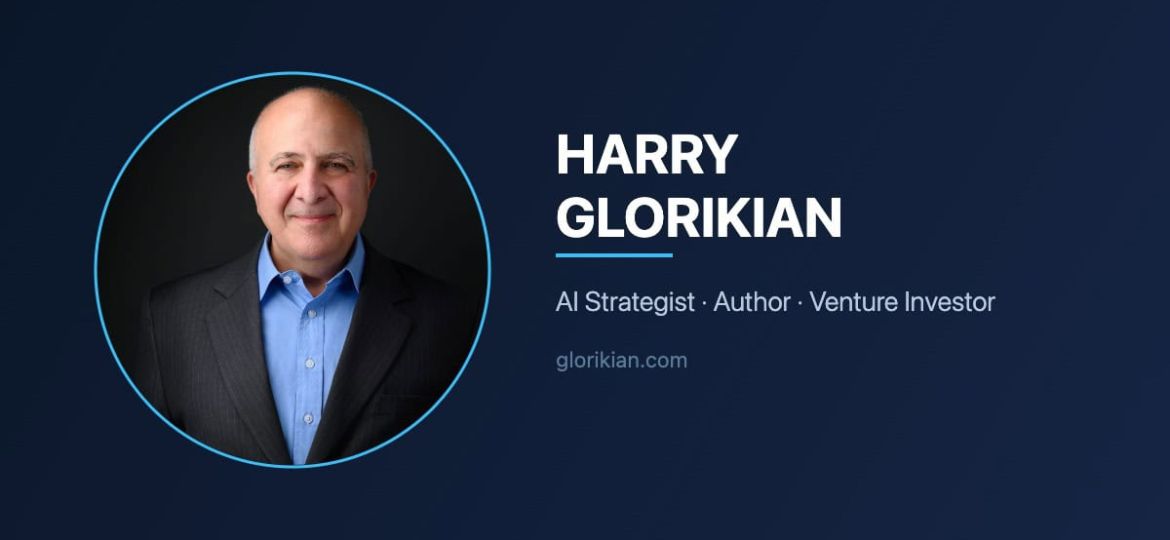
Harry Glorikian is Managing General Partner at Scientia Ventures and a Visiting Researcher at the MIT Media Lab. His book The Invisible Interface: How AI Turns Intentions Into Actions, And Who Wins (Simon & Schuster, June 2026) is available now. He hosts The Harry Glorikian Show. He also speaks on AI strategy for boards and executive teams.