America Needs Open-Source AI at the Frontier
I’ve been asking whether I could run AI under my own control and still get the quality I need for my research, investing and the work I delegate to it. This became more than a question about buying a new souped-up computer (which I continue to debate). If a system becomes important to how I think through a problem and get work done, shouldn’t I have some say in how it develops and who operates it?
A company bringing AI into its business should face similar questions. Imagine an engineering firm that wants to adapt a model to its design process and eventually sell what it develops. A commercial AI service might meet its needs, but access to the model itself would let its engineers investigate a recurring error and test changes of their own, including improvements the original developer had no reason to pursue.
I believe the United States should support a sustained nonprofit effort to develop open-source AI at the frontier, the leading edge of what these systems can do. The aim should include advancing that edge, while giving companies and individuals a foundation they can use and improve. In August I wrote a piece called “Who Owns the Innovation Loop?” It argued that the advantage goes to whoever controls the cycle of experiment and evidence that produces the next advance, and this piece follows that argument into AI itself.
What open source adds
First, we need to be clear about what “open” means, because a model you can download is not necessarily open source. Under the Open Source Initiative’s definition, open source also gives people the right to study, change and share the system, along with its code and enough information about its training data to support that work.[1] The engineers in my example could then test the model on their own problems, look into why it keeps making the same mistake and try a fix without sending their designs to anyone, although confidence would still have to come from the results.
Shared research can become the starting point for a company’s own product. Ricursive Intelligence, whose AI platform designs computer chips, says it started its training experiments from a method the nonprofit Ai2 had published, then trained its own model from scratch.[2] OpenRSI Foundation researchers used AI agents to look for ways to speed up open software that runs speech systems, and the developers who maintain it reviewed and merged the changes for everyone who uses it.[3]
For individuals, the concern becomes clearer as an assistant takes on more work. In The Invisible Interface, I explore how AI moves from answering questions to carrying out intentions. An assistant doing that could remember a project’s history and the reasons behind your decisions, and changing providers could mean losing years of useful information. Open models could help create alternatives, but people would also need a way to move that history to another service and safely reconnect their applications.
A country faces the same question at a larger scale. I was just at Digitec 2026 in Yerevan, Armenia, where I got to listen to NVIDIA’s Rev Lebaredian give a keynote in front of a slide that read “Open Models Turn Knowledge into Advantage.” NVIDIA has chips to sell, so I listened with that in mind. But he also told the conference that building every part of the AI industry is beyond any single country, whatever its size.[4] For a country of about three million people, an open model is one part it does not have to build. It can run that model on its own infrastructure, in its own language and under its own laws, which is what sovereignty can realistically mean for a small country.
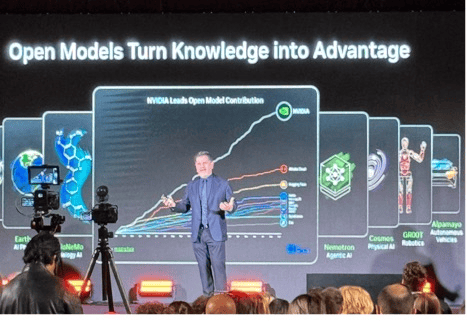
NVIDIA’s Rev Lebaredian at Digitec 2026 in Yerevan, November 20, 2026. The cards behind him name the company’s open model families, from biology to robotics and autonomous vehicles. Photo by the author.
Who holds the strongest tools
There is already considerable work to build on. Ai2 and Open Athena, another nonprofit, publish their methods as well as their models, and companies including NVIDIA, Meta and OpenAI release models anyone can download, each under its own terms.[5] But in Artificial Analysis’s broad set of tests, the strongest models that aren’t available to download still score higher than the best downloadable ones, and the three highest-scoring downloadable models all come from developers in China.[6]
We also can’t assume that a subscription buys everything a developer has built or could build. OpenAI’s quarterly report to California’s Office of Emergency Services describes employees working with approved models that had not been released to customers.[7] Anthropic says that in training its newest models it deliberately held back progress in a narrow set of research skills that could most directly speed up AI development.[8]
AI is now helping to build AI. In November the independent evaluation group METR judged that Anthropic’s models were probably improving on well-defined tasks about twice as fast as they had between early 2024 and late 2025. It also judged that most of that speedup was likely due to how heavily the company uses AI in its own research, while stressing substantial uncertainty.[9] If AI helps researchers build better AI, access to those tools could affect who takes part in the next advance, which is why I would aim for an open effort that helps set the frontier rather than one that always follows behind.
Access can also stop for reasons no customer controls, as it did in June, when a U.S. export-control order aimed at foreign nationals led Anthropic to switch off a newly launched model for all of its customers for nearly three weeks.[10] On The Long Game podcast, Dwarkesh Patel said he worries that AI companies will stop offering their most powerful models to outside customers, and the conversation turned to what could follow if a developer kept its strongest systems and sold the finished services instead.[11] No one has shown that any company plans this, but it could turn our engineering firm’s supplier into a competitor.
What a frontier effort would take
I don’t fault the companies for any of this. Private companies have no general obligation to share every advance with competitors, because they invest to build an advantage and have legitimate reasons to protect their research. Many now argue for open models themselves, and in July NVIDIA’s Jensen Huang shared a letter, since signed by more than 270 organizations including Microsoft, Google and OpenAI, urging Washington not to restrict open models prematurely. Open models, he wrote, “strengthen safety and cybersecurity, accelerate innovation and diffusion, and enable sovereignty.”[12] I welcome that, but a company opens a model when doing so serves its strategy and can stop when it no longer does.
A nonprofit effort would serve a different purpose, which is to keep its research and its released models available for others to use and improve even as its leaders and funders change. That should cover what researchers tried and what the tests showed, including the experiments that failed.
The cost cannot be treated as a one-time investment, because developing leading AI means paying for the experiments that fail as well as the ones that work. Epoch researchers estimated that at three AI companies the final training runs behind released models accounted for roughly a tenth to a quarter of each company’s spending on computing for research and development.[13] So I would start by strengthening existing institutions with several years of government, donor and industry support, alongside commercial income where possible, and tie further support to technical progress and to evidence that outside researchers and smaller businesses can afford to use the results. Money alone would not close the leading companies’ advantages in data, customer feedback and technical talent, so capable management, clear research goals and substantial computing would matter as well.
Open doesn’t have to mean decentralized. Training a leading model favors large, tightly connected clusters of computers,[14] so the research needs a professional team at its center, with outside groups contributing code, experiments and independent testing. Because the release would be open source, more than one professional operator could run the finished model, so individuals could choose among services without running anything themselves and larger businesses could operate their own copies. Companies could also grow up around the research, as Red Hat did around open software, or be owned by the nonprofit, as Mozilla’s foundation owns a commercial company, although neither precedent shows how to pay for frontier AI.[15]
The security trade-off
The July letter argues that many teams inspecting a model will find and fix more of its flaws, and the UK’s AI Security Institute calls downloadable models “the lifeblood of open research and innovation in AI.” The institute is just as direct that their safeguards take little time or money to strip out and that a release cannot be undone, a point the letter also concedes.[16]
Some models may therefore have to be held back, although an effort that kept its strongest models closed for good would defeat its own purpose. Where testing justifies it, the nonprofit could keep a model on its own computers and still let outside researchers test and modify it there. That model would not be open source, and the nonprofit should say so, explaining what it is withholding, what would justify release and what outside reviews conclude. It would also need independent oversight, including of its own use of AI to develop more capable models, because neither openness nor central control guarantees security.
How I would judge the investment
Other countries, including competitors, would benefit from whatever we release, and American funding could not reserve those gains for Americans. That is a cost, but the White House’s 2025 AI Action Plan sees “geostrategic value” in open models because they could set standards used around the world.[17] Countries that want to run their own AI will build on someone’s open models, and today the strongest downloadable ones come from China. So, I would judge the investment first by whether it helps our researchers and businesses develop technology of their own, gives individuals a choice of operators and justifies a cost that does not end, and then by whether other countries choose to build on American open models.
Business leaders don’t have to wait for any of that to find out where they stand. They can ask whether they can examine and adapt the model their work runs on, whether they could move their history and applications if their access stopped, and what their supplier is keeping for itself.
Sources
1. Open Source Initiative, The Open Source AI Definition – 1.0.
2. Ricursive Intelligence, Ripple development account, 2026. Company report.
3. OpenRSI, OpenRSI x SGLang-Omni: Scaling RSI for AI Infra, November 9, 2026. Performance figures are the project’s own.
4. NEWS.am TECH, report of Rev Lebaredian’s remarks at Digitec 2026, November 20, 2026, which reports his view that developing every layer of the AI industry is beyond even the largest countries. The slide title is from the author’s photograph of the keynote.
5. Ai2, Olmo 3: Charting a path through the model flow to lead open-source AI, November 20, 2025. Marin, Marin 8B Retrospective, and Open Athena, Scaling Marin’s Open LLM Pre-Training, November 2026. NVIDIA, Nemotron 3 Ultra model card. Meta, Introducing Muse Spark Open, The Most Capable US Open-Weight Model to Date, October 15, 2026. OpenAI, open models page.
6. Artificial Analysis, model comparison and Intelligence Index v5.0.1, as checked November 19, 2026, when the leading model scored 65 and the highest-scoring downloadable model scored 46. The three highest-scoring downloadable models were Kimi K3.1 Pro, DeepSeek V4.1 Flash and GLM-5.3. On their developers, see NIST, CAISI’s Assessment of Z.ai’s GLM-5.3 Cyber Capabilities, September 17, 2026, and CAISI Evaluation of DeepSeek V4 Pro, May 1, 2026.
7. OpenAI, Periodic Summary of Internal Use Catastrophic-Risk Assessments, the public version of its quarterly report to the California Office of Emergency Services, covering June 4 to September 4, 2026.
8. Anthropic, Claude Fable 5.2 and Mythos 5.2, November 9, 2026, Safeguards section, which says coding, hardware development and conventional AI research were not affected.
9. METR, Independent Assessment of AI R&D Acceleration at Anthropic in October 2026, November 5, 2026. METR did not test unreleased models itself, and it reports that Anthropic redacted most of the evidence METR found most informative.
10. Anthropic, statement on the U.S. directive to suspend access to Fable 5 and Mythos 5, June 12, 2026, and Gyana Swain, US reverses export restrictions on Anthropic’s Fable 5, Mythos 5 AI models, CIO, July 1, 2026. Fable 5 launched June 9, was switched off June 12 and returned July 1. Mythos 5 was restored earlier to a limited set of U.S. organizations.
11. The Long Game with Jake Sullivan and Jon Finer, Dwarkesh Patel on the World After AI’s Next Leap, November 12, 2026, at about 43 minutes.
12. Open Weights and American AI Leadership, July 24, 2026, as hosted by Microsoft, which listed more than 270 signing companies and organizations as of August 3, 2026. Huang’s post is quoted in Nick Lichtenberg, report on Huang’s first post on X, Fortune, July 24, 2026.
13. Jean-Stanislas Denain and Cheryl Wu, Final training runs account for a minority of R&D compute spending, Epoch AI, March 23, 2026. The three companies are OpenAI, MiniMax and Z.ai, and the figures are estimates.
14. NVIDIA, Parallelisms Guide, Megatron Bridge documentation.
15. Red Hat, subscription model FAQ. Mozilla, The Mozilla Corporation.
16. UK AI Security Institute, Managing risks from increasingly capable open-weight AI systems, August 29, 2025, and the letter in note 12.
17. The White House, Winning the Race: America’s AI Action Plan, July 2025, section “Encourage Open-Source and Open-Weight AI.”