What AI’s Math Breakthroughs Could Put Within Reach
From chip designs to drug research, better math could change which ideas we can afford to test.
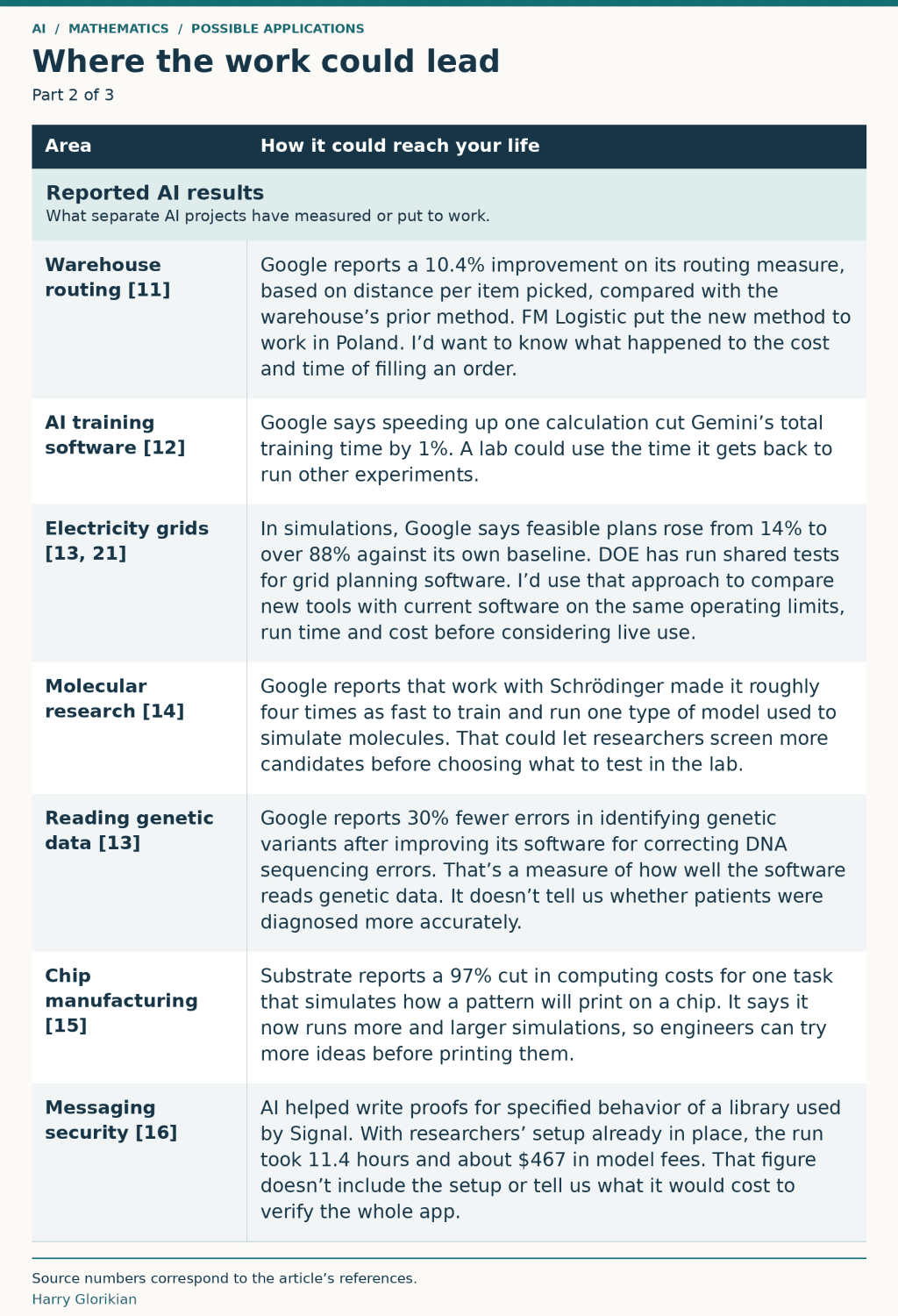
A warehouse in Poland changed the routes people take to fill orders. FM Logistic says the new routes can save more than 9,000 miles of travel a year at that site. It used a tool from Google DeepMind to find a better way to group orders and decide which shelves to visit first, without adding to its forklift fleet or investing in more infrastructure. [11]
The chip company Substrate used the same tool, AlphaEvolve, to improve software that simulates how patterns will print on silicon. It reports a 97% cut in computing costs for one optimization task, and says its team is now running more simulations, including larger ones. That’s what interests me: the engineers have more room to investigate before they commit to printing. [15]
OpenAI’s October math papers prompted me to look more closely, alongside work from Anthropic and Google DeepMind. [9] [12] [19] I’m not a mathematician at this level, so I used several AI systems to help sort through the research and follow the possible uses. The warehouse and chip projects were separate work. They helped me understand what an improvement could look like once someone put it to use.
Once a team can afford more simulations, I want to know which ideas get another look. Google reports that work with Schrödinger made it roughly four times as fast to train and run one type of model used to simulate molecules. [14] That could let a drug researcher compare more candidates on a computer before deciding which ones to make and test in the lab. It could also help the team rule out a weak candidate before spending lab time on it.
The fourfold figure tells us how much faster that model ran. To understand its value, I’d want to follow the team’s choices: did a molecule make it into the lab that would previously have been passed over? That’s where a saving in computing time could start to change what gets discovered, with any benefit to patients still to be established.
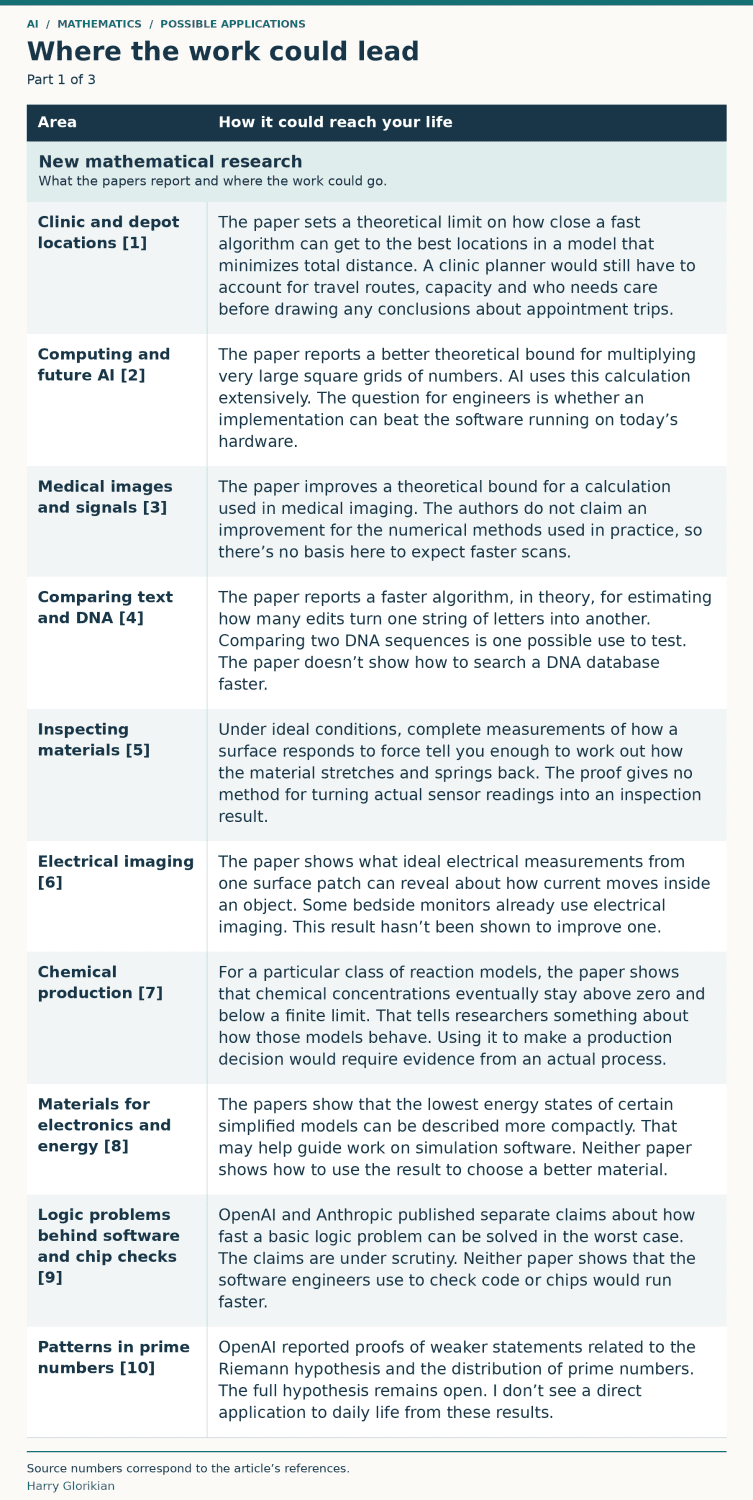
One of the new proofs concerns how much you can learn about the inside of a material by measuring how its surface responds to force. Under ideal conditions, that information is enough to determine how it stretches and springs back, though turning the finding into a useful inspection method is a separate research problem. [5] And a result about prime numbers can be important mathematics even when I can’t point to a product it will improve. [10] I’ve kept those distinctions in the table below.
OpenAI withdrew three papers after a sign error in one undermined two others that relied on it. [19] The Simons Foundation, Anthropic and OpenAI have committed $15 million in combined funding and resources to help researchers evaluate and work with AI results. [20] Mathematicians need the time to check these results and explain which methods other researchers can build on.
I’d put public money into tests others can learn from, as the U.S. Department of Energy (DOE) has done with grid planning software. [21] That gives the next operator evidence to start with and less work to repeat. A country that helps its companies apply good methods sooner could give them an advantage, though I’d still want to know whether any savings reach customers.
I keep coming back to the experiments a research team leaves out of its plan because it can’t afford to run them. If better tools change that calculation, I’d want to go back through that list. There may be something worth trying that never got its chance.
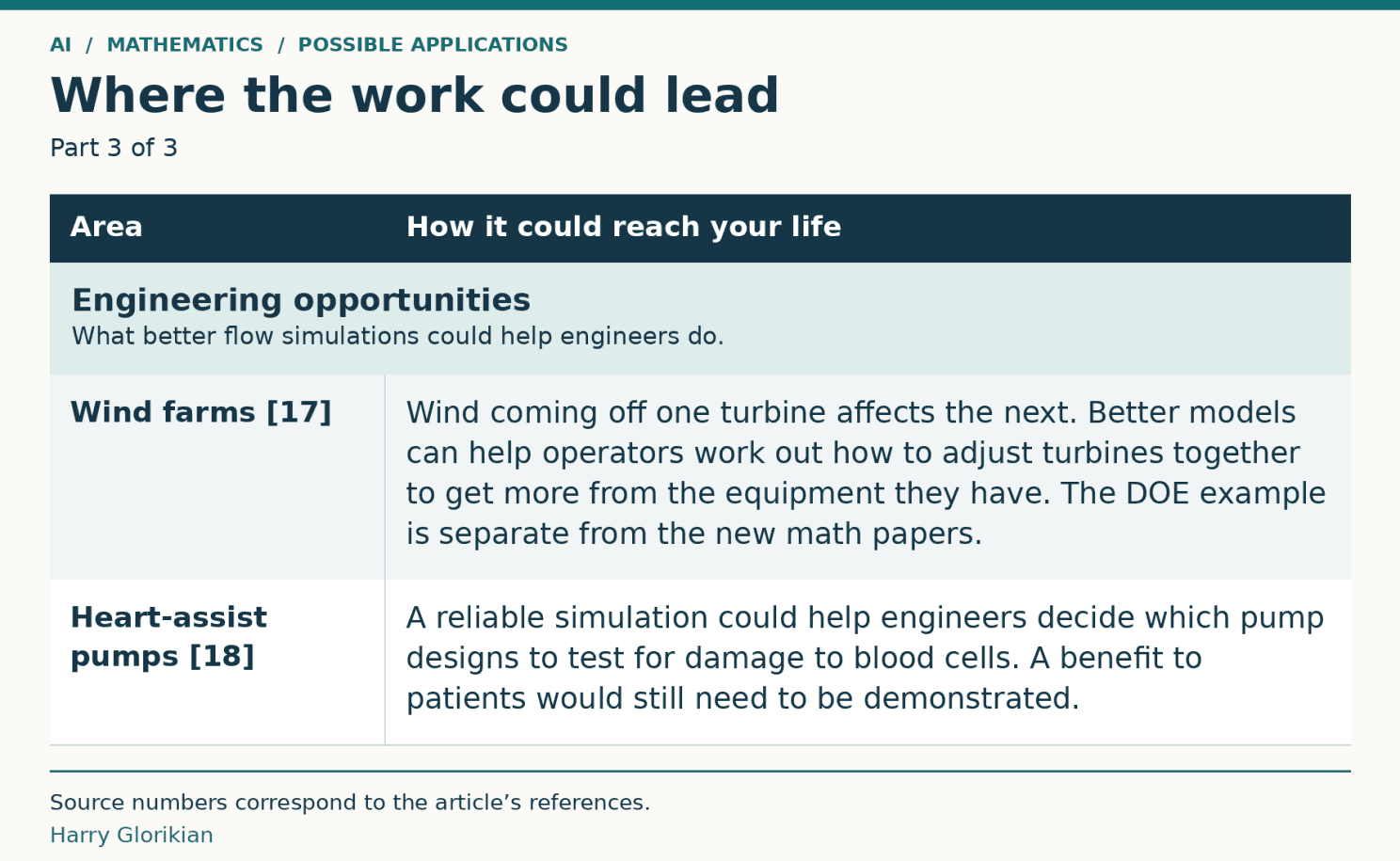
Where the work could lead
The table keeps new mathematical claims, results from separate AI projects and possible engineering uses distinct, so you can see where the evidence stands.
Sources
1. OpenAI site-selection result, September 24, 2026.
2. OpenAI matrix multiplication; Shpilka follow-up; NVIDIA implementation background.
3. OpenAI Fourier-transform result; NVIDIA medical and scientific applications.
4. OpenAI edit-distance result.
5. Scope of the elasticity result; OpenAI elasticity inverse problem, September 24, 2026.
6. OpenAI partial-boundary conductivity result; Dräger existing electrical-imaging technology.
7. OpenAI chemical-network permanence result, October 5, 2026.
8. OpenAI quantum area law; PEPS representation result; Argonne materials-research context.
9. OpenAI’s Exponential Time Hypothesis preprint; Anthropic’s separate 3-SAT preprint, October 27, 2026; independent examination and discussion; Microsoft constraint-solver applications.
10. OpenAI’s quasi-Riemann preprint; Follow-up quasi-Riemann manuscript; Quanta’s analysis, October 19, 2026; Clay Institute on the full hypothesis.
11. FM Logistic and Google warehouse routing case, March 26, 2026; FM Logistic on deployment, June 10, 2026.
12. Google DeepMind AlphaEvolve, May 14, 2025.
13. Google DeepMind grid and genomics reports; Google on the grid simulation, May 7, 2026.
14. Schrödinger molecular-calculation case, July 1, 2026. See also DOE catalyst background and FDA drug-development stages.
15. Substrate computational lithography report, April 7, 2026. The 97% figure concerns computing costs for the same optimization task, not the cost of manufacturing a chip.
16. CryptoProver study, revised October 16, 2026; WIRED on formal software verification, October 29, 2026. The study checked specified behavior of a library, not the whole Signal app.
17. DOE wind-farm modeling and control research, October 15, 2024; Lex Fridman Podcast 503 transcript, Steven Brunton at 1:32:47 to 1:34:45 and 1:48:36 to 1:49:49.
18. FDA benchmark study of flow simulations and blood damage in medical devices; FDA comparison of predictions and measurements for a blood pump.
19. OpenAI’s October mathematics announcement; OpenAI mathematics release history; WIRED on the October release, October 6, 2026.
20. Simons funding announcement, October 15, 2026; OpenAI academic collaborations, October 26, 2026.
21. DOE grid optimization test cases and results; PNNL problem formulation.