The Fifth Question
What happens if your competitor gets the best AI model first?
The AI-and-jobs question lands on every operator’s desk eventually. Someone asks. An investor asks. The CFO asks. The pressure is the same whether you run a company of five people or fifty thousand. It can cause sleepless nights and very difficult decisions without a clear framework.
If AI can do more of the work, what happens to our people, our costs, and our advantage?
The first answer is still role by role. That was the point of the Four-Question Role Screen. Pick a role. Score it. Decide whether it needs a transition plan, an augmentation plan, or a rerun in six to twelve months.
There is a second question now. What if the work can be done, but the best AI model is not equally available? What if your competitor gets it earlier, with bigger usage limits, faster response times, or wrapped inside a software product you can only buy six months later?
That is the fifth question.
The same AI capability can make one company stronger and another company weaker. The split depends on who captures the savings: the company, the customer, the software vendor, or the competitor down the street.
The access gap is not theoretical anymore
On April 7, 2026, Anthropic launched Project Glasswing. Twelve founding partners, including Amazon, Apple, Cisco, CrowdStrike, Google, JPMorganChase, Microsoft, NVIDIA, and Palo Alto Networks, along with roughly forty additional vetted organizations, get access to a new model called Claude Mythos Preview for defensive cybersecurity work. Anthropic has stated it does not plan to make Mythos generally available. After the credit pool runs out, the price for participants is $25 per million input tokens and $125 per million output tokens. That is five times the cost of Claude Opus 4.6. The rest of us are not on the price list. We are on the waiting list. The announcement is at anthropic.com/glasswing.
On May 11, OpenAI followed with Daybreak. Three tiers: standard GPT-5.5, GPT-5.5 with Trusted Access for Cyber for verified defenders, and GPT-5.4-Cyber, a cyber-permissive variant for organizations defending critical infrastructure. Cisco, Cloudflare, CrowdStrike, Palo Alto Networks, Oracle, and Akamai are among the early partners. Details at openai.com/daybreak.
Energy is the second access constraint. The International Energy Agency estimates that data centers used about 415 terawatt-hours of electricity in 2024 and projects roughly 945 terawatt-hours by 2030 in its base case. You do not double global data center load over six years without choosing who gets the new capacity.
And there is hard evidence that access changes performance. A 2023 NBER working paper by Brynjolfsson, Li, and Raymond studied 5,179 customer support agents at a Fortune 500 software company. The agents who got access to an AI assistant resolved 14% more issues per hour on average, and 34% more for novice and lower-skilled workers. That was a plain chatbot. Not a frontier cyber model. The competitor across the street having a capability you do not have is no longer an abstract concern. It shows up in productivity numbers.
You do not always need the most powerful model
The most powerful model is not always the right model. Using it for everything is one of the fastest ways to burn cash with nothing to show for it at the next board meeting.
Routine work like classifying documents, routing tickets, drafting first-pass replies, matching invoices, and summarizing call notes mostly needs reliability, speed, and cost control. Not frontier reasoning.
Frontier capability earns its price tag when the task is ambiguous, multi-step, adversarial, high-value, or expensive to get wrong. Cybersecurity is the clean example. So is complex software engineering inside a large codebase. So is high-stakes compliance interpretation. So is long-running autonomous agent work where a small capability bump changes the economics of an entire workflow.
| Workflow type | Model choice | Why |
|---|---|---|
| Status updates, ticket routing, document extraction, first-draft replies | Cheaper, smaller model | Output is structured and easy to check. Cost and speed matter most. |
| Billing, audit, claims triage, document comparison | Cheaper model first, stronger model on the edge cases | Most items are routine. The exceptions need a stronger model or a human review. |
| Pricing decisions, compliance reasoning, large-codebase changes | Frontier model on the hard cases | Judgment, context, and the cost of being wrong outweigh the per-task price. |
| Cybersecurity vulnerability discovery, exploit validation, high-risk autonomous work | Restricted or trusted-access frontier | Capability and safeguards both matter. This is where access becomes strategic. |
Use the cheapest model that reliably passes the test. Escalate only when the task fails or the cost of failure is high.
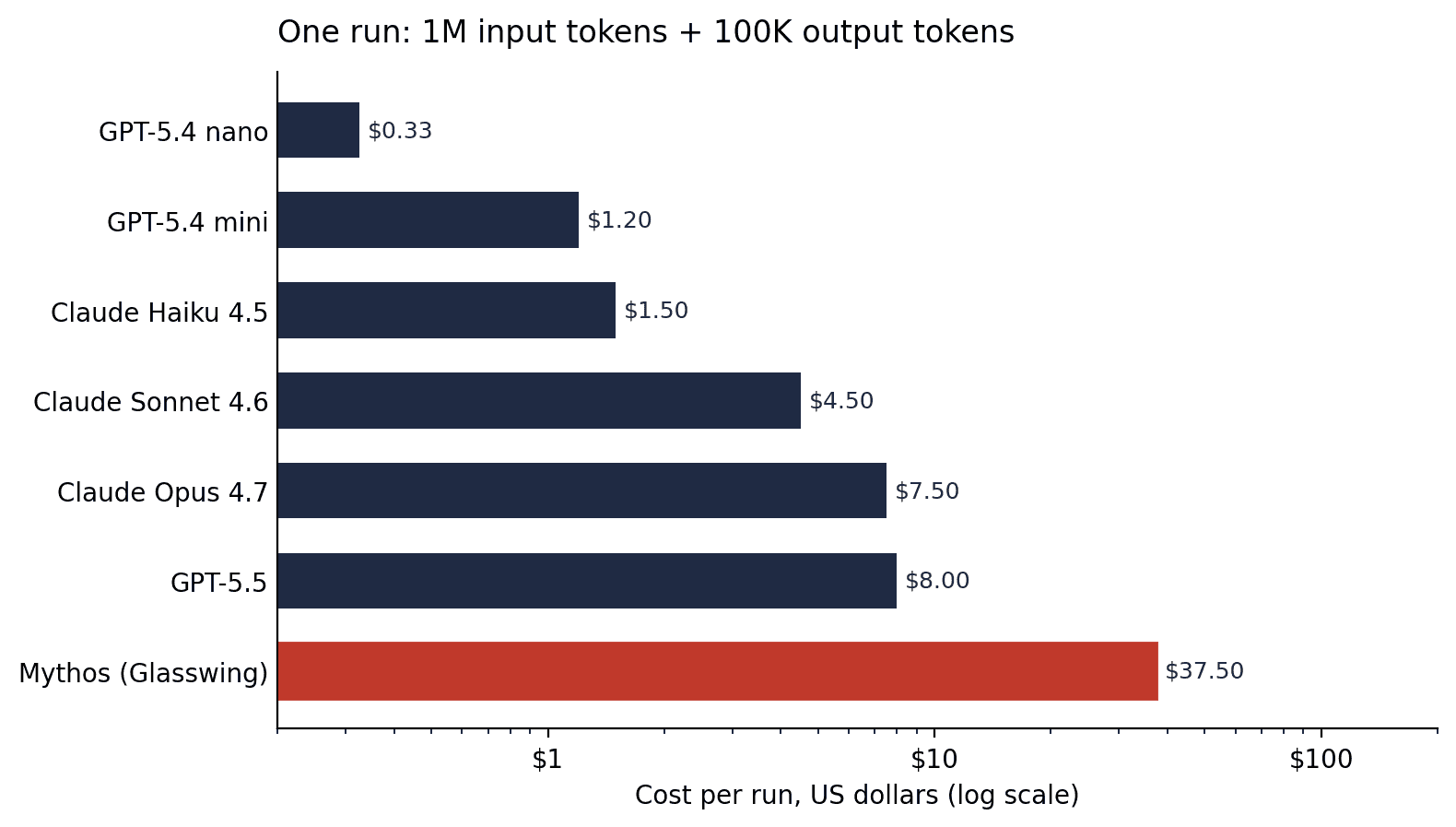
Figure 1. Cost of one moderately large AI job at public list prices, May 2026. A token is the unit AI providers use for billing. Roughly one token is three-quarters of a word, so one million tokens is about 750,000 words. This chart shows the cost of an interaction that sends in one million words of input and gets back about 75,000 words of output. Mythos Preview pricing applies only to Glasswing participants. The gap from bottom to top is not a rounding error. It is a strategic decision about every workflow you run.
The four-question screen, in plain English
Exposure indices are too blunt. They count tasks that can be automated and imply that a job with a lot of them is at high risk. That is not how real work behaves.
Real jobs are bundles of related tasks. Pull some tasks out of a complex role and the worker often becomes more valuable on what remains. Pull the one task out of a narrow role and the wage bill is on the table.
The screen asks four questions, each scored one to five.
| Question | What it asks |
|---|---|
| Dimensionality | How few essential tasks make up this job? |
| Demand elasticity | If the output gets cheaper, do customers want more of it? |
| ROI to full automation | Is the full wage bill realistically on the table? |
| Competitive pressure | Are competitors already forcing the move? |
Add the four. Sixteen or higher is red, meaning the role needs a transition plan. Twelve to fifteen is yellow, meaning the role needs an augmentation investment. Below twelve is green, rerun in six to twelve months. That is the tool.
What it does not capture is unequal access to the AI capability itself. That is what the fifth question fixes.
The fifth question
The question. Would this role become strategically exposed if a competitor, vendor, or AI provider had better access to a frontier model than we do?
One post-score modifier. Applied only to yellow and red roles.
| Score | Meaning |
|---|---|
| 0 | Better access does not materially change the role’s economics. |
| 1 | Better access makes the competitor more efficient. |
| 2 | Better access changes the competitor’s cost structure. |
| 3 | A software vendor or AI provider could package the workflow and own the margin. |
Final risk score equals the four-question score plus the fifth-question modifier.
The modifier is not a prediction. It forces a question management teams keep dodging. If somebody else gets the better AI first, do we lose a little efficiency, or does the math behind the role change?
Freight, in one paragraph
The freight brokerage matrix in the role screen (in the original piece link above) post produced eight red, eight yellow, and nine green roles across twenty-five positions. Apply the fifth question and the picture sharpens. Track-and-trace scored 19 on the original four, plus a 3 because software vendors are already packaging the workflow, brings the total to 22. Billing and accounts receivable at 17 plus a 3 is 20. Those were not borderline roles. The wage bill is gone the moment a competitor signs the contract. The first mid-market broker to buy the packaged stack gets a temporary edge. Then every broker buys the same stack. The edge disappears. The advantage moves to data quality, customer relationships, exception handling, and operating discipline.
Sticker price is not outcome cost
This is where the cost conversation usually breaks down. The number on the AI provider’s pricing page is what you pay per AI job. The number that matters is what you pay per job that delivers a result you can use.
A cheap model that gives wrong answers nobody catches is expensive. A frontier model that produces a usable result on a high-value job can be cheap. The way to know is to track how often the output works, how much human review it needs, how much rework happens, how long it takes, and what the result is worth to the business.
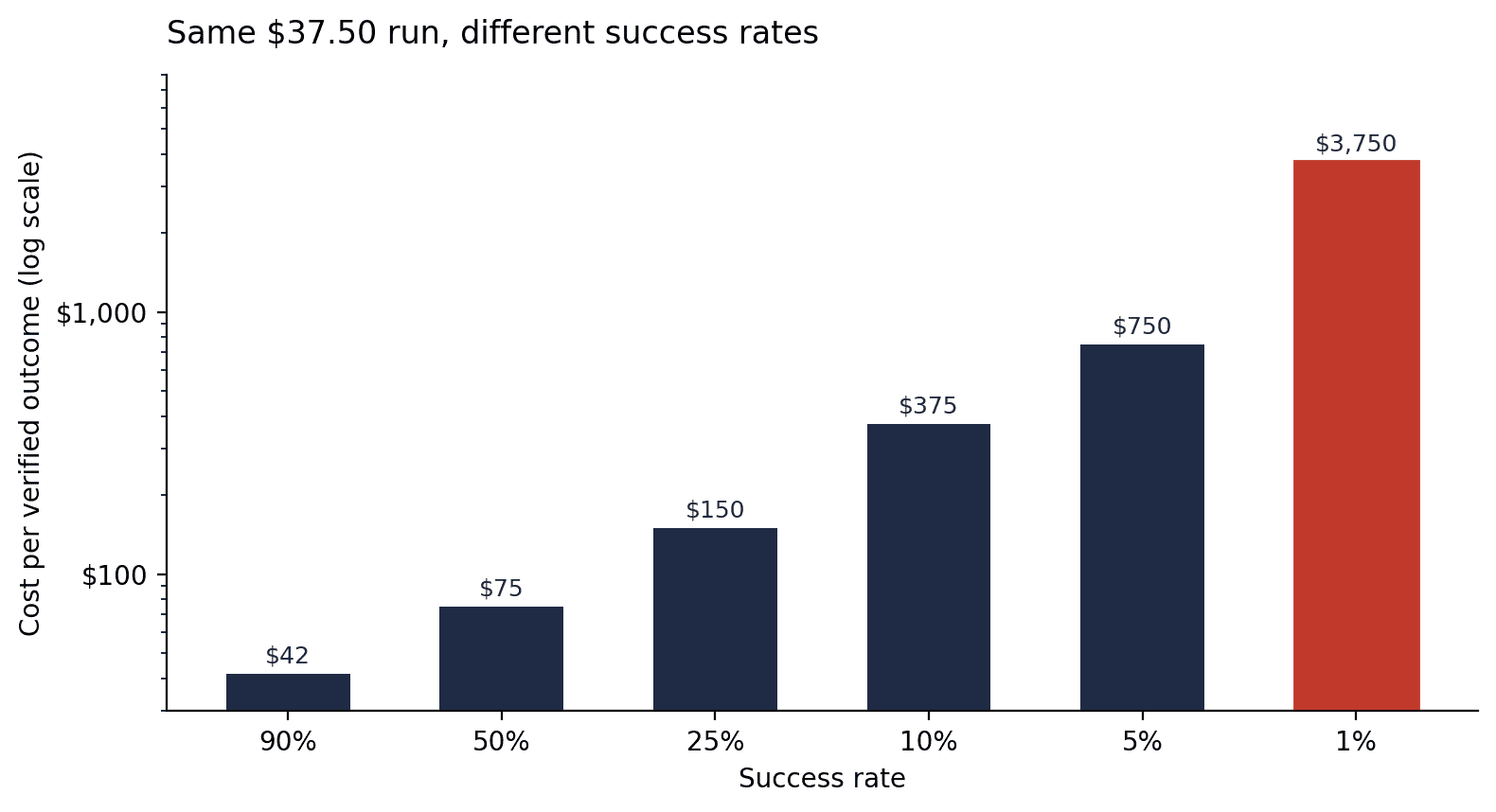
Figure 2. The same $37.50 Mythos job delivers very different economics depending on how often the output is usable. At 50% usable, the cost per result is $75. At 1% usable, it is $3,750. The sticker price is the smallest part of the calculation.
Packaged access is not automatically bad
Easy to overstate this risk. When a software company or AI provider sells a finished workflow that does the work, that is often the right answer for a mid-market buyer. Most companies do not want raw AI access. They want fewer errors, faster cycle time, lower cost, cleaner handoffs, and less day-to-day operational drag.
The risk is not buying the product. The risk is treating the product as your strategy.
If the same product is available to every competitor, the advantage shifts from owning the tool to running it better. If the software vendor captures the workflow data, the advantage moves toward the vendor over time. If the AI provider keeps the strongest capability internally and uses it to run their own version of your workflow, you are competing with your supplier. Three different risks. Track them separately.
Energy policy is access policy
Policy is not the center of this piece, but it matters here because the rules around building data centers determine who gets compute access.
Communities are right to ask for power, water, ratepayer, tax, labor, and security protections around new data centers. A federal moratorium bill introduced in March 2026 would pause construction of new AI data centers above 20 megawatts of power demand until national safeguards are in place. The concern behind it is real. Communities are being asked to absorb the local costs of buildout.
But if compute is already constrained, a broad pause on large facilities does not redistribute access. It freezes it. The firms with existing capacity keep what they have. Everyone else waits, pays more, or gets pushed into more restricted access tiers. A local protection becomes a national access lock.
The better answer is not build everything and is not pause everything. It is paid-for, secure, accountable buildout. Developers pay for the infrastructure they trigger. Communities get enforceable protections written into the permits. Public-interest users get a clear path to access before the frontier capability is contracted to incumbents.
What to bring back to your leadership team
- Run the four-question screen on the roles that drive the most payroll, delay, error, or operating friction.
- Apply the fifth-question modifier only to yellow and red roles.
- For every exposed workflow, separate the work that needs frontier capability from the work where a cheaper model is the right answer. Show the math.
- For every exposed workflow, name who captures the savings: the company, the customer, the vendor, or the competitor.
- Identify any workflow where a software vendor or AI provider could become the margin owner. Decide whether that is acceptable.
- Negotiate access, usage limits, response time, model-version rights, data rights, audit rights, and exit rights. Not all in one contract. But all on the table.
- Build a fallback path for every workflow that depends on a single AI provider.
- Rerun the screen in six months. Scores move.
The point
AI will not reprice work evenly across companies. It will reprice work through capability, through access, through workflow design, and through speed of implementation.
Do the analysis now. Not after the frontier has moved.
References
Harry Glorikian, The Four-Question Role Screen
Anton Leicht, Cut Off, Threading the Needle, May 13, 2026
International Energy Agency, Energy and AI
Brynjolfsson, Li, Raymond, Generative AI at Work, NBER WP 31161
AI Data Center Moratorium Act, March 2026 announcement
About the book
Harry Glorikian is the author of The Invisible Interface: How AI Turns Intentions Into Actions, And Who Wins (Ideapress Publishing, distributed by Simon & Schuster, June 2026). Learn more or get it on Amazon.
If this resonated with you
The Invisible Interface
My new book explores how AI is creating an invisible operating layer between businesses and their customers — and what that means for every leader making strategy decisions today. Available now.